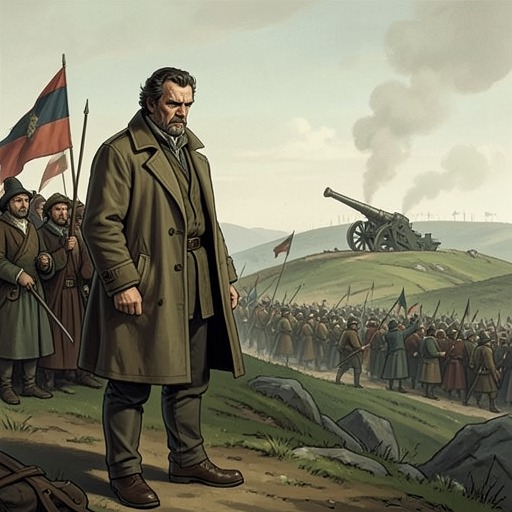
Henry V’s Military Discipline Policy in France
Henry VHenry V’s Military Discipline Policy in France is King Henry V’s stated attempt to control the English army’s conduct in enemy territory. It forbids coercion and unpaid seizure from villages and forbids contemptuous verbal abuse of French people, presenting restraint as both a rule for soldiers and a way to win a kingdom. The policy’s force is complicated by the play’s other scenes: threats against Harfleur, a soldier’s challenge to the justice of the war, and the order to kill prisoners at Agincourt expose the distance between disciplined conduct and violence under pressure.
Orders for the Army in France
After a soldier associated with the robbery of a church has been punished, King Henry V declares that such offenders should be cut off. He then gives express instructions for the army’s marches through the country: nothing is to be compelled from villages, goods are to be taken only when paid for, and French people are not to be insulted or abused in disdainful language. The scope is concrete and practical. The orders address the army’s conduct toward local communities and their property, not simply its behavior in battle.
The policy thus makes military discipline a matter of restraint as well as obedience. Soldiers are not to treat their passage through France as permission to requisition at will or humiliate its inhabitants. King Henry V presents this restraint as strategically consequential, reasoning that when leniency and cruelty contend for a kingdom, the gentler side is more likely to prevail. The maxim links treatment of civilians to the outcome of conquest: controlled conduct is not merely a limit on soldiers, but part of the king’s argument for how authority can be won.
War’s Claims and Its Human Cost
The policy appears within a campaign whose justification is already contested. Before the invasion, the Archbishop of Canterbury asks that the Salic Law be examined in relation to the English claim to France. King Henry V warns that awakening the sword between two kingdoms will bring great bloodshed. The Archbishop, by contrast, urges the king to send bodies, blood, sword, and fire to secure his right. These exchanges place the discipline orders beside competing accounts of responsibility: war is argued over as a claim to justice, but its consequences fall on bodies and communities.
At Harfleur, King Henry V’s language sharply contrasts with his later rules for the marches. He declares that he will not leave the town half-conquered, threatens that it will lie buried in ashes, and says that the gates of mercy will be shut so that soldiers may range with bloody hands. The policy’s prohibitions on coercion and abuse therefore do not erase the play’s presentation of threatened violence against a besieged population. Instead, the contrast shows how the king’s stated restraint operates alongside the force by which he seeks to compel surrender.
The question of a just cause also reaches the soldiers themselves. Michael Williams argues that if the cause is not good, the king will face a heavy reckoning when the bodies of those killed in battle join him at judgment. His objection shifts attention from military success to moral liability: the king’s authority does not, in Williams’s view, settle whether the deaths caused by the campaign are justified. The discipline policy addresses what soldiers may do to French villagers, while Williams’s challenge presses the larger question of who bears responsibility for the war and its dead.
The Test at Agincourt
The sharpest rupture comes during the Battle of Agincourt. When the French reinforce their scattered forces, King Henry V orders every soldier to kill his prisoners. A later explanation attributes the order to the French burning and carrying away everything in the king’s tent; the speaker consequently calls the order worthy and praises the king. The play gives the command a stated battlefield circumstance, but does not reconcile it with the earlier image of a ruler who limits cruelty through disciplined conduct.
The contrast matters without making the marching orders meaningless. Those orders specifically govern treatment of French villagers and the taking of their goods during the army’s passage; the prisoner-killing order arises amid renewed fighting and is justified afterward by the attack on the king’s tent. Yet both episodes concern the king’s power to direct violence, and the play leaves their ethical tension visible. A policy of restraint can shape the army’s conduct in one setting while failing to protect captives in another.
Meaning and Limits
The policy joins military command to a political claim: English authority in France is to be exercised without arbitrary seizure or disdainful abuse of the population. Its language makes restraint an instrument of rule, but the surrounding scenes prevent that principle from becoming a simple account of a humane campaign. Threats at Harfleur and the killing of prisoners at Agincourt expose the coercive violence that accompanies the effort to win France.
The policy’s significance therefore lies both in its specific protections and in the pressure placed upon them. It gives the English army a stated standard for conduct in the countryside, while the play sets that standard against the king’s own threats, the soldiers’ doubts about justice, and a consequential order on the battlefield. The resulting tension leaves discipline neither a guarantee of ethical warfare nor an empty gesture: it is a real command whose boundaries and limits become part of the drama of kingship and war.